D-BOX G5 with Assetto Corsa Rally: This Is How High-End Haptics Should Be Presented
Laser-scanned stages, every pothole with its own depth, and a motion platform that can transfer bumps straight to your body. At SimRacing Expo in Frankfurt, I tried Assetto Corsa Rally with D-BOX G5.
MBy matus_ace
At trade shows like SimRacing Expo in Frankfurt, expensive hardware is easy to find. High-end wheels, pedals, cockpits, and motion platforms are practically everywhere. What’s much harder to find is a demonstration that can genuinely explain in just a few minutes why a particular technology is worth spending a lot of money on. In my view, Canadian company D-BOX pulled it off exceptionally well. All it needed was the right game.
That game was Assetto Corsa Rally, which stands out from other rally simulators thanks to one particularly important feature. Its stages are created using laser scans of real roads, so they aren’t just rough recreations of familiar routes. The developers also capture small bumps, dips, rises, and changes in the road’s profile. Those details create ideal conditions for showing what a quality haptic platform can do.
When the road is more than a texture
In most racing games, we experience the surface primarily through what we see. We can spot gravel, asphalt, a pothole, or a bump, and driving over them may also register as a vibration through the wheel. Modern simulators can, of course, account for surface irregularities, but Assetto Corsa Rally puts greater emphasis on precise geometry. Potholes, jumps, and changes in elevation aren’t just graphical effects here. They have a real spatial form that the game can account for as the car moves. And when you add D-BOX G5, you suddenly experience those details with more than just your eyes and hands. You feel them with your whole body.
That was what impressed me most about the whole demonstration. The cockpit didn’t need to tilt dramatically or throw me out of my seat every time I went over a bump. What was far more impressive was how it conveyed individual surface irregularities. Driving through a pothole produced one response, while a rise produced another; a significant change in the road’s profile made the whole car’s movement perceptible. The individual cues didn’t feel like generic jolts intended to make the terrain seem rough. Together, they created a convincing impression that there was genuinely uneven road beneath the car—not just a surface for a virtual vehicle model to drive across.
In my view, this is exactly when haptic technology starts to make sense even to someone who has only encountered it in videos or technical presentations. The monitor shows you what’s ahead, the wheel conveys how the front wheels are behaving, and D-BOX adds another layer of information you simply don’t get when playing at home without it.
What is D-BOX, and what makes it stand out?
D-BOX is one of the best-known names in professional haptics and motion simulation. The Canadian company develops systems used not only for gaming, but also for training professional racers. Its technology is also officially licensed by the Fédération Internationale de l’Automobile (FIA), with D-BOX serving as its exclusive official supplier of haptic systems.
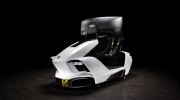
The system is built around electromechanical actuators mounted beneath the cockpit. They can change its position while also producing extremely subtle vibrations. The combination of these two capabilities is key. A motion platform doesn’t just have to simulate a car tilting under braking, acceleration, or through a corner. It can also convey surface texture, engine vibrations, curb strikes, and changes in tire grip.
D-BOX operates at frequencies of up to 100 Hz, allowing it to handle very small, rapid cues as well as larger movements. This is especially important when simulating uneven surfaces, where the response has to keep changing. It’s not just about the strength of each jolt, but above all its accuracy, timing, and transitions between cues.
The system also supports games with custom haptic profiles. With titles such as Assetto Corsa Competizione and iRacing, it can provide feedback designed specifically for each game. Adaptive Gaming Mode is also available, allowing it to generate haptic feedback for games without this kind of direct support.
During my time with Assetto Corsa Rally, however, what mattered wasn’t exactly how the game communicated with the platform. The result was what counted. And it was phenomenal.
G3 or G5? I went with the newer generation
D-BOX demonstrated two generations of its system at the show: the older G3 and the newer G5. Since I had the chance to try the newer model, I went straight for it. With this kind of hardware, I was most interested in seeing how far the technology had come.
The differences between the generations aren’t just cosmetic. The G3 uses larger external ACM control units, which take up space outside the cockpit and make cable management more complicated. The G5 introduces a much more compact setup with a smaller Haptic Bridge control unit. The actuators and their wiring have also been redesigned, and each actuator in the new generation can switch between 120 V and 230 V power.
The newer generation is therefore more practical to install and easier to integrate into existing setups. In the standard G5 configuration, a single actuator can handle a load of approximately 114 kg and has a maximum stroke of 38.1 mm. That might not seem like much on paper, but with haptics, the point isn’t to move you by dozens of centimeters. The G5 can also be expanded to support up to six degrees of freedom with additional hardware. The ability to adjust the intensity of individual effects and create custom profiles is important, too.
Since I didn’t try both generations back to back on the same setup and in the same game, I don’t want to claim that the G5 is better than the G3 by a particular amount when it comes to driving. It may not be a matter of one being directly better or worse, as D-BOX representatives also pointed out. They’re simply different generations with some different features, but the same purpose. I can say that the newer generation’s response felt exceptionally precise and natural. With this kind of hardware, that matters more than flashy movements that look good on video.
A cockpit where everything worked together
The setup itself wasn’t built around D-BOX technology alone. I sat in a cockpit equipped with Fanatec components, so the wheelbase, steering wheel, and pedals were all up to the task. An Advanced seat provided the comfort and added to the racing feel. But that’s not what matters most here. I mainly wanted to find out how precise physics, detailed surface modeling, and a motion platform worked together.
And the combination worked brilliantly. The brakes and steering wheel gave me control over the car, while D-BOX conveyed what was happening beneath it. The individual components didn’t feel like separate attractions; they felt like parts of a single system.
Of course, a few minutes behind the wheel at a trade show can’t replace long-term testing. I didn’t have time to try different haptic settings, compare profiles, or find out how the system would feel after several hours of driving. But it was more than enough to make a very strong first impression.
This is how technology should be presented
In the end, what impressed me most about the experience wasn’t just the hardware itself. D-BOX showed how important it is to choose the right game when demonstrating a technology.
You can demonstrate a motion simulator with all kinds of racing games. You can put a visitor in a fast car on a circuit, let them take a few corners, and show how the seat tilts under braking. That can be impressive, too. But Assetto Corsa Rally offers something that shows off D-BOX’s advantages even more convincingly.
Its laser-scanned stages create plenty of opportunities to make use of subtle haptic feedback. Every pothole, bump, jump, or change in surface can feel different. There’s no need to add dramatic effects artificially, because the road itself provides plenty of cues. The technology doesn’t have to draw attention to itself with exaggerated movement. It simply conveys what’s happening in the virtual world.
That’s exactly why I consider this demonstration exceptionally successful. D-BOX G5 didn’t just show me that it can move a racing cockpit. It showed me how much information about a car’s behavior and the character of a stage we miss when playing normally.
In this case, Assetto Corsa Rally and D-BOX G5 complemented each other so well that it was hard to imagine a better demonstration of what the technology can do. That doesn’t mean everyone needs a similar setup at home. This is high-end hardware that requires a substantial investment and plenty of space. D-BOX G5 4250i costs 7000 euros. You’ll also need to factor in a frame, seat, pedals, steering wheel, and so on. But for anyone looking for the most convincing way to turn a virtual drive into a physical experience, this combination shows just how far sim racing can go today.












Comments