GTA VI Technical Analysis: Uses FSR 4 on Xbox Series S, Runs More Stably on PS5 Pro
Even on the least powerful console, the game retains ray-traced lighting. Digital Foundry has also examined the graphics and performance on every console.



GTA VI takes the technical design of open worlds to a new level, but its exceptional environmental detail comes at the cost of a 30 fps cap on all consoles. Rockstar has now revealed the exact resolutions and upscaling technologies used by each version. Most notably, the game uses AMD FSR 4 on Xbox Series S, where it retains ray-traced global illumination and reflections despite the console’s weaker hardware.
The developers confirmed that they had targeted 30 fps from the start. Given the scale of the simulation, the graphics and the number of interactions, they considered this the best compromise. They also worked to significantly reduce input latency compared with GTA V and Red Dead Redemption 2.
Resolution and performance on each console:
On all platforms, the final image is combined with a user interface rendered in 4K. Rockstar uses different image reconstruction technologies depending on each console’s capabilities.
PS versions:
FSR 4 helps Xbox Series S retain advanced graphics
Xbox Series S is particularly interesting from a technical perspective. GTA VI is the first game to use AMD FSR 4 on the console (surprisingly, it isn’t used on Xbox Series X). The technology reconstructs a higher-quality 1080p image from a low 720p internal resolution. More importantly, Rockstar didn’t have to remove key graphics technologies, including ray-traced global illumination, reflections and the simulation of individual strands of hair.
There are, of course, trade-offs. On Series S, ray-tracing effects are lower quality, shadows are less precise, textures are softer and volumetric clouds have lower resolution. Object and vegetation pop-in is also more noticeable when driving at speed. Even so, Digital Foundry views the graphics positively, as most of the main visual features have been retained.
Performance is a bigger issue, with Series S regularly falling below the 30 fps target. Digital Foundry suspects one of the main limitations may be the console’s 10 GB of memory, which has to handle both the extensive simulation and the world’s continuous streaming.
PlayStation 5 Pro offers the best graphics and most stable performance
At the other end of the spectrum is PS5 Pro, which Digital Foundry says offers the best console version of the game. Although it renders internally at the same 1440p resolution as the base PS5 and Series X, PSSR2 reconstructs the image to look very close to native 4K. The difference in sharpness and detail compared with the base PS5 is significant.
PS5 Pro also uses ray-traced shadows, providing more precise and natural-looking shading. The other consoles use traditional shadow maps, which Digital Foundry says also deliver very good quality.
The biggest difference is performance stability. The analyst played more than 50 hours on PS5 Pro without recording any frame rate drops during regular gameplay. Only deliberately triggering massive explosions in the streets managed to bring performance down to 24 fps. Minor drops occur more often on the base PS5 and can last longer when there are many explosions. XBOX Series X also mostly holds 30 fps, but experiences more pronounced drops in exceptionally demanding scenes.
Digital Foundry highlights the lighting and world detail
Both of Digital Foundry’s technical analyses describe GTA VI as one of the most impressive realistically rendered games of this generation. The outlet particularly praises the use of ray-traced global illumination and reflections throughout the open world. The result is naturally lit interiors, realistic reflections on a variety of surfaces and an exceptionally convincing atmosphere at sunrise and sunset.
Rockstar has completely overhauled materials in the RAGE engine, which now respond to light according to the physical properties of real-world surfaces. This is visible on car paint, glass, concrete, wet asphalt and characters’ clothing. The entire lighting system was designed from the outset for both HDR and SDR. Digital Foundry measured HDR peak brightness reaching at least 1500 nits.
Hair simulation is another major technical achievement. According to Digital Foundry, many NPCs use a strand-based system in which each strand has its own physics, allowing it to move naturally and react to wind and moisture. When wet, hair changes both its appearance and behaviour, and its simulation remains consistent during gameplay and cutscenes. DF calls this system one of the best it has seen in video games so far. Plus
Rendering distant environments is equally impressive. Rockstar can keep traffic, pedestrians and city lighting visible over long distances, while transitions between levels of detail for objects are exceptionally smooth. The city looks natural from the air, and at night its lights remain visible all the way to the horizon.
The technical presentation is rounded out by a procedural system for volumetric clouds and local weather. Storms can form only in certain parts of the map, while cloud cover, rain and lighting conditions alter the look of the entire environment. Water physics respond to the character of each location. Other details include smoke that casts shadows, realistic car deformation and small-scale physical interactions with the environment.
30 fps is the trade-off for the scale of the simulation
Despite its enthusiasm for the graphics, Digital Foundry notes that GTA VI is not entirely free of technical shortcomings. Ray-traced reflections can produce noise on some surfaces, moving objects sometimes exhibit ghosting, and reflection artifacts are also visible on glass in certain situations.
The biggest drawback, however, remains the 30 fps cap, even on PS5 Pro. The outlet also acknowledges that the game looks exceptionally impressive at this frame rate and offers more responsive controls than Rockstar’s previous titles.
GTA VI shows how far open-world graphics can be pushed on the current generation of consoles. Rockstar has used the available performance not just for a better-looking image, but also for a larger-scale simulation, denser environments and numerous systems running simultaneously. It is this combination that makes GTA VI one of the most technically ambitious titles of this generation.

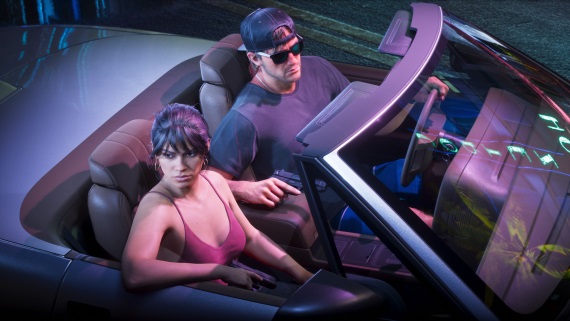 GTA VI Is Set to Send Millions of Students and Workers on Unplanned Leave
 GTA VI Preloads Are Now Available; Rockstar Confirms 30 FPS and PS5 Pro Enhancements
 Grand Theft Auto VI highlights its PS5 features in a new trailer
 GTA VI Preloads Are Now Available; Rockstar Confirms 30 FPS and PS5 Pro Enhancements
 GTA VI Is Getting Its Own Music Festival in Miami, Featuring Travis Scott, Cardi B and More
Popular stories from the last 30 days
Feed4Gamers © 2026







Comments