Gears of War: E-Day pushes Unreal Engine 5 further, as Digital Foundry breaks down MegaLights, ray tracing and console performance
The SSD in Xbox Series S serves as expanded memory.



The Coalition and Epic have brought several experimental Unreal Engine 5 technologies into a real game. The result is one of the most technologically advanced console games today, although performance is not without issues everywhere.
Digital Foundry took an in-depth look at the technical side of Gears of War: E-Day, which it says represents one of Unreal Engine 5’s biggest technological leaps in recent years. While the game itself returns to the series’ roots with a more grounded prequel, it takes the opposite approach from a technological perspective. The Coalition worked closely with Epic Games during development, helping bring several experimental technologies into production.
The biggest new feature is MegaLights, a new Unreal Engine 5 ray tracing system for direct lighting. While Gears 5 could handle around three shadow-casting lights, and E-Day was initially expected to use around six to ten, MegaLights effectively removes that limit.
Scenes can now contain thousands of shadow-casting lights. The system uses a fixed number of ray tracing samples per pixel, so its cost does not increase directly with the number of light sources. This is especially noticeable in night scenes, where streetlights, police beacons, flashlights, ambulances and other smaller lights can cast shadows.
MegaLights also enables more realistic soft shadows. Their sharpness and width change according to the distance between an object and the light source, as well as the source’s size—something that is much harder to simulate with traditional shadow maps. Muzzle flashes are another notable feature: in E-Day, they can realistically illuminate the environment and cast shadows, both for the player and enemies.
The Coalition significantly optimized the system in collaboration with Epic Games. When Epic first demonstrated the technology in 2024, the demo ran on PS5 at around 1080p and 30 fps. The Gears developers optimized it to the point that, according to technical director Kate Rayner, it is now more than twice as fast, allowing E-Day to use it while targeting 60 fps on consoles.
Gears of War: E-Day uses hardware ray tracing on both PC and consoles in every graphics mode. Hardware Lumen handles indirect lighting and ray-traced reflections, which can also show animated characters.
The game originally combined software and hardware Lumen depending on the available hardware. The Coalition eventually removed the software solution entirely, however. Its distance fields used memory, complicated development and added a performance cost. The developers ultimately reached the somewhat unusual conclusion that using hardware ray tracing in E-Day was also a performance optimization.
Hardware Lumen also handles global illumination, including secondary light bounces off the environment. The player’s flashlight, for example, can contribute to GI.
On supported Nvidia GPUs, E-Day can also use Mega Geometry, a technology that allows ray tracing to work with much more detailed geometry.
The Coalition uses it in E-Day to increase the complexity of ray-traced geometry by approximately 50 to 100 times. The RT representation can therefore closely match the detail of the Nanite models used for rasterization, resulting in more accurate shadows and reflections.
Another major new feature is Nanite Skinning. E-Day uses Nanite not only for static environments, but also for animated characters—something major Unreal Engine 5 games have not really done so far.
To achieve this, The Coalition completely reworked its character system. The main characters do not use MetaHuman, and the team created its own rigs, morph targets and shaders.
Key differences compared with Gears 5:
The result is more detailed models that retain their high quality up close, without any visible transitions between traditional LOD models.
E-Day also features a new destruction system. Some cover and objects can be completely destroyed, while others break apart over time or sustain surface damage. Glass responds to individual impacts by forming holes and cracks, and some scenes feature more extensive environmental destruction.
Interestingly, hardware ray tracing is even used in some cases to calculate particle collisions.
Animations use motion matching, which automatically finds the most suitable animation in a database based on current movement, player input and pose, then transitions smoothly between animations. Digital Foundry rates the results highly, noting that the characters look natural while controls remain responsive.
On Xbox Series X, players can choose Performance, Balanced or Quality mode.
All modes use dynamic resolution, with the final image reconstructed using Temporal Super Resolution. Digital Foundry generally rates the image quality highly, although the 60 fps mode is noticeably softer.
Quality mode additionally offers ray-traced Lumen reflections on translucent materials, strand-based hair for the main characters and, in some cases, higher-quality shadows. Performance mode uses MegaLights more aggressively and may reduce, for example, vegetation density in the distance.
On Series X, Performance mode can maintain 60 fps through much of the game. It works best in traditional linear sections, where drops are minimal.
Issues begin to appear in larger urban areas. E-Day is not an open-world game, but according to Digital Foundry, around half of it features larger spaces where players can move more freely between objectives.
These areas are where regular frametime spikes and occasional longer drops occur. The Coalition identified streaming, memory management and CPU load in these scenes as the main challenges.
Digital Foundry therefore recommends combining a 120 Hz output with VRR, which can mitigate many of these issues. Balanced mode holds 40 fps steadily most of the time, although drops can still occur in larger areas. Quality mode is even more stable at 30 fps.
Testing took place before the day-one patch was released, so the final version of the game may have some performance improvements.
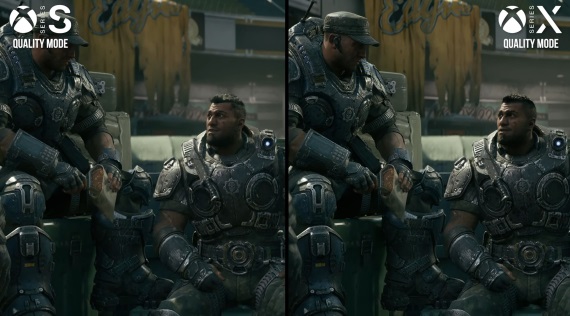
Series S presented a significantly tougher optimization challenge for The Coalition. The biggest issue was not the processor itself, but the available memory.
The internal resolutions for each mode are approximately:
Despite these low figures, Digital Foundry considers the resulting image relatively clean thanks to TSR.
Performance mode makes more significant graphical compromises:
Balanced and Quality modes retain more graphics features, but Series S does not use strand-based hair.
The Coalition worked with the Xbox platform team and Advanced Technology Group on an unusual solution to the lack of RAM on Series S.
The developers use the NVMe SSD as part of an expanded memory hierarchy. The system can automatically identify data that is not needed every frame and move it to the SSD. This allowed the developers to effectively expand the game’s available memory by around one gigabyte without a visible impact on performance.
Series S performance remains the game’s weaker point, however. Performance mode has more frequent drops and stutters, some lasting over 100 ms. Balanced mode targets 40 fps but also loses performance in more open areas. Even Quality mode can suffer from stutter and drops in demanding areas.
Using a 120 Hz output with VRR significantly improves the situation, but does not eliminate the issues entirely.
Digital Foundry ultimately describes Gears of War: E-Day as one of the most visually impressive Unreal Engine games. During development, The Coalition directly helped Epic Games optimize and develop technologies that were originally only experimental engine features.
Some of the work created for E-Day was later added back to the main Unreal Engine 5 branch, allowing other developers to benefit from it as well.
E-Day combines:
The game can deliver all of this on Series X while targeting 60 fps. Its weaknesses are frametime issues in larger areas and more significant compromises on Xbox Series S. From a technological perspective, however, Digital Foundry sees E-Day as practically the next stage in the evolution of Unreal Engine 5 games at the AAA level.
Popular stories from the last 30 days
Feed4Gamers © 2026









Comments