Game of Thrones: War for Westeros will let you rewrite the history of Westeros
An exclusive interview from Gamescom with Ryan McMahon - from the birth of Game of Thrones: War for Westeros, through the campaign, to multiplayer and the future of the game.
TBy tomass
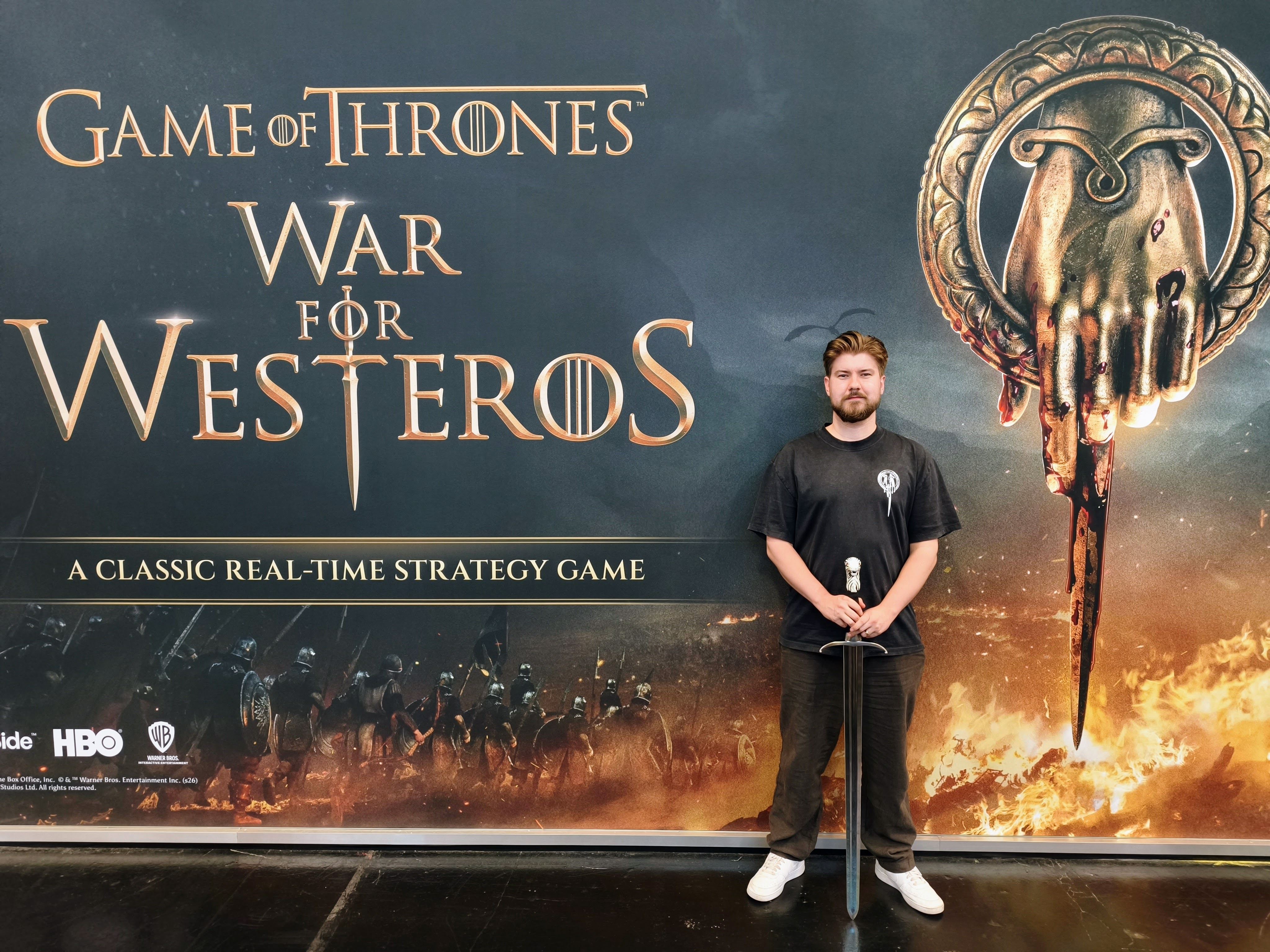
At Gamescom we got a rare chance to sit down with Ryan McMahon, one of the creators of War for Westeros. The conversation had a friendly tone, though we did occasionally try to catch Ryan off guard and get answers out of him about parts of the game that haven't been revealed yet. He was careful — but even so, he let slip a few interesting details we hadn't known about before the interview. We also have to praise the decoration of the interview room itself, which was full of props from the show: swords, furniture, dragon eggs and other themed pieces.
Let's start with the basics. Where did the idea come from to make a Game of Thrones game as a real-time strategy?
It all started with Age of Darkness, our first RTS title. When we began pre-production on that, we were very inspired by Game of Thrones, particularly "The Long Night" episode in the final seasons. We built the game around the idea of you being the last bastion of hope, fighting for the light of humanity against hordes of nightmares and darkness closing in on you.
A lot of that inspiration came from Game of Thrones, to the point where, after Age of Darkness, we were looking at what we could do next - and we got the opportunity to work on the Game of Thrones licence. It felt like a natural next step. As massive fans of the show, bringing Game of Thrones to the RTS genre, which we also love, just felt like an awesome opportunity.
Did you also cooperate with George R. R. Martin directly, or is everything handled through the franchise managers?
We work directly with Warner Bros., who hold the licence together with HBO. Specifically, we work with their licensing team, which oversees the Game of Thrones franchise. We consult them on everything we want to do - they approve all the assets in the game, as well as a lot of the designs. We have a good creative relationship with them. And if they need to, they talk directly to George or his agents for approval as well.
I'm asking because a lot of people are writing and talking about the game as a chance to finally wipe out the last seasons of Game of Thrones and take the story in a completely different direction. Was that intentional on your part, or is it something the audience projected onto the game?
I think it's just naturally being taken that way. Our intent was for you to tell your own story in Westeros more than anything else. It's about giving players a lot of different options within each faction, across all the seasons. There's no specific point in time in which the game takes place - you'll see Tywin Lannister and Robb Stark, who definitely aren't around in the later seasons. You have the ability to tell your own story within Westeros and decide how you want that fate to end.
When I started playing the demo, I felt a lot of inspiration from the old classics - The Lord of the Rings: The Battle for Middle-earth, above all.
Yes, The Battle for Middle-earth II is a big inspiration for us, as well as Dawn of War, Company of Heroes, Age of Empires and StarCraft - all fantastic games. From a gameplay perspective, we lean into squad-based combat, because it suits the IP well and lets you field larger army numbers faster. And generally, if you follow the trend of licensed IP in RTS, they've all done very well - Battle for Middle-earth, Halo Wars, Star Wars, Dawn of War.
I really appreciated how familiar it feels for RTS players. I didn't read anything, I didn't watch a tutorial - I just started the game to see whether I could play it, because a lot of new RTS games are so complex that they need very specific controls you have to study first. Here I immediately knew what I should be doing, and I was right.
That's awesome to hear. That's great.
I do have some questions about multiplayer and the skirmish mode. We could play two of the houses in the demo. When I play Lannisters against Starks, the two sides feel comparable in power. But how do you handle balance when, for example, I play the Starks against the Targaryens? They have dragons - what are my options for taking a dragon down?
Balance is obviously an important part of an RTS, but it isn't what we prioritise. We lean into what's cool - the rule of cool. So these things that look powerful or even overpowered, like dragons, that's okay. We want them to be strong. The time and effort it takes to get to them is where the real work is. Once you reach that point, it's a moment you've unlocked and achieved - and the other player could have stopped you from getting there, and maybe they didn't.
But even then, every faction has its own late-game power moment, which gives them the ability to counter each other's late-game options. The Starks have access to giants, mammoths and catapults. Giants can switch stances between their giant club and their bow. Once they go into bow mode, they become a stationary ballista of sorts, shooting giant arrows at whatever they target - and that allows them to shoot at dragons. Similarly, the Lannisters have access to wildfire and scorpions.
Can you tell us more about the Night King's army and its playstyle? From the material I read, I understood that when the army dies, it resurrects and keeps fighting. Did I misunderstand that?
The Night King has the ability to raise the dead to fight for him. So when your armies die, he can raise some of your units to join his army of the dead.
So when I play as the Night King, I don't produce armies the way I do with the Lannisters or the Targaryens?
You didn't play the Night King in the demo - you would have had access to the Starks and the Lannisters. We haven't showcased the White Walkers yet, and we haven't showcased the Targaryens yet either.
Understood - that's exactly what I wanted to know about, so let's come back to it in the future. What are the differences between the campaign and multiplayer in terms of playstyle? Is it something completely different, or similar?
It's similar. Everything revolves around the core skirmish mode, regardless of whether it's multiplayer, single-player versus AI, or the campaign. In the campaign you play in a sandbox structure, where the player decides how they want to conquer Westeros. Westeros is divided into territories, and to take one you play a skirmish match. You're still playing a skirmish the way you normally would, but there may be extra modifiers on top to change things up for the campaign experience.
How does cooperation and negotiation with other territories and houses work - including betraying them?
There will be alliances, betrayals and the high stakes we all know so well from Game of Thrones.
Will that be handled through mini-games, cutscenes - how should we imagine it?
We'll share more about that when we talk about the campaign in the future.
In multiplayer there were hero powers. Can you tell us more about them, and do you plan to add heroes and powers we haven't seen yet?
Yes - we actually announced two new heroes earlier this week. At the showcase last night we revealed the Mountain and Arya Stark as two new heroes joining the game. The Mountain is recruitable by the Lannisters and Arya by the Starks.
They play very differently. The Mountain is more of a tank-style hero, while Arya is more of an anti-hero specialist who executes enemies, steals their faces, morphs into them, and can even use their abilities afterwards. So the roster now includes Jon Snow, Robb Stark, Ghost, Grey Wind, Jaime Lannister, Tywin Lannister, the Targaryens and the Night King - and it will keep expanding as we head towards launch. Every single hero plays slightly differently and has their own set of abilities you can use to change the shape of a battle.
When I finish or progress through the campaign, do I get cutscenes or short films like the intro?
When you complete the campaign, you'll be rewarded with a moment showcasing your victory - ultimately, who you chose to sit on the Iron Throne. We hinted at that in our gameplay reveal, with the different characters looking towards the Iron Throne, so expect to see more of that.
Can you explain the counter-unit system in multiplayer?
Every unit in the game has a unit role and a unit type. That's basically the Venn diagram of how we design units - it's our version of rock, paper, scissors. The unit type is what the unit is. You might have a cavalry unit, which is a character riding a horse, or an infantry unit, which is a foot soldier. There are additional layers on top of that, too - they may be heavy cavalry or light cavalry, light infantry or heavy infantry. That informs what they are as a unit.
Then there's the role, which answers: what am I good at, what can I do as a unit? Those are tags like anti-cavalry, anti-light, anti-heavy, anti-infantry. Because infantry is on foot by nature, I'm naturally going to be slower than cavalry, but maybe I deal more damage. If I'm heavy, I may be slower again, but have more health and deal more damage with a lower attack speed. All of these things shape how their stats work, and then their role gives bonuses to those stats so they actually outperform whatever they're meant to counter.
There's no limit to how many roles a unit can have. They could be anti-infantry and anti-cavalry, or anti-heavy and anti-cavalry - and that's essentially what makes a unit good at what it does. Each unit fits somewhere on our Venn diagram, so we can see what type it is, how many roles it has against other units of that type, and from that work out how much it should cost and how many models the squad should contain.
What's your favourite playstyle in multiplayer?
I really like working my way through the tech tree to the late-game units. If I'm playing the Starks, I love to move quickly and get to giants really early. Same for the Lannisters - I like to rush through and try to reach wildfire early. There are also early rush strategies that are sometimes really fun: expanding quickly, getting cheaper units on the field, capturing all the territories and seeing whether your opponent can keep up. But if they start to match that pressure, I like to pull back, focus on my economy and build up my tech so I reach the late game before my opponent and have the stronger units.
Which faction is better suited to a defensive playstyle, and which to an offensive one?
The Starks will be the best defensive faction, in terms of how we're designing them, and the Targaryens will be the strongest on offence. We actually approach this for every faction with a rubric: how defensive they are, how offensive they are, how good their economy is, and how complex they are. Every faction sits somewhere on that as a kind of tier list, with the Starks being the most defensive and the Targaryens the most offensive.
Maybe you can't answer this one, but do you have a post-launch roadmap? Can we expect DLC?
We'd love to support the game post-launch, but we won't be revealing what that looks like until closer to launch - which is early next year, early 2027.
That's all my questions for the official part. I genuinely enjoyed the demo. It hit exactly the spot I look for, because modern RTS games often aren't for me, while I've put thousands of hours into the older ones. This feels fresh, from a franchise everyone loves, and it's really cool to play in Westeros with the great houses.
Awesome - I'm glad you like it. We're very excited about it as well.








Comments